

Saffracin™
Saffron (Crocus sativus L.) stigma extract, crocins standardized to 35.0 to 37.0% by HPLC

What is it made from?
Saffracin™ is an ingredient extracted solely from the stigma of saffron (Crocus sativus L.). Each saffron flower yields only three stigma threads, so about 150,000 flowers are needed to obtain 1 kg of dried raw material.
The content of crocin and safranal, the representative active compounds of saffron, is measured by HPLC (high-performance liquid chromatography) and standardized so that each batch maintains consistent levels.
Ethanol and water are used as extraction solvents, and the finished product is supplied as a fine reddish-brown powder. The detailed extraction process is protected as a trade secret of the manufacturing partner.
Used in a marketed product
Saffracin™ is the raw material of ATTENSAF®, a 10 mg capsule (60 per bottle) marketed in Iran since February 2022.
Source: Samanik toxicology and safety statement L04-R2 (20 October 2026). ATTENSAF® is produced by Samanik Salamat Gostar Co. (Iranian manufacturing licence IRC 2973817054220888).
Key active compounds
Saffron contains more than 150 compounds. Saffracin™ uses the following three as its standardization markers
CROCIN
Crocin
A carotenoid glycoside that gives saffron its red color and accounts for a substantial share of saffron’s weight, making it the representative marker compound. Saffracin™ is standardized to 35.0 to 37.0%.
SAFRANAL
Safranal
A volatile monoterpene aldehyde that gives saffron its characteristic aroma. It forms when picrocrocin breaks down during drying and processing, and Saffracin™ is specified at 0.10% or higher.
PICROCROCIN
Picrocrocin
A glycoside that gives saffron its bitter taste and acts as a precursor of safranal. It is monitored as a reference marker during quality control.
Specification
Every lot ships with a Certificate of Analysis.
| Parameter | Specification | Method |
|---|---|---|
| Crocins | 35.0 to 37.0% w/w | HPLC |
| Safranal | 0.10% w/w or more | HPLC |
| Appearance | Fine red powder | Visual |
| Ash and loss on drying | 5% or less each | Gravimetric |
| Heavy metals | 10 ppm or less | Atomic absorption |
| Microbiology | Total count 10³ cfu/g or less, yeast and mold 10² cfu/g or less, pathogens negative | USP |
| Shelf life | 3 years, sealed container, protected from moisture | Lot CoA |
Ten recent lots (2023 to 2026) measured crocins 35.4 to 36.7%, mean 36.1%, all within specification. Source: Samanik CoA Saf-202301 to Saf-202601 (HPLC).
Clinical evidence
Saffron extract has been studied in 15 clinical trials published in 16 peer-reviewed papers. The trials were led by Prof. Shahin Akhondzadeh’s group at Tehran University of Medical Sciences (TUMS).
Indications: ADHD, depression, Alzheimer’s disease, premenstrual syndrome, sexual dysfunction, type 2 diabetes and menopausal depression. Samanik has confirmed in a signed statement (L07-R2, 20 October 2026) that all 16 papers were conducted with Saffracin™, and Prof. Akhondzadeh has confirmed in writing that the study extract was supplied by Samanik. Most trials were small, and none was designed to prove equivalence.
Clinical dose and Saffracin™
Seven papers state the crocin content of the study capsules. Their dose of two 15 mg capsules a day contains about 3.4 mg of crocins (1.65 to 1.75 mg per capsule).
One 10 mg capsule covers the trial dose. The other nine papers do not state crocin content, so their doses (20 to 60 mg a day) are quoted as printed in each paper.
Head-to-head trials
| Study | Indication | Comparator | Participants | Duration | Result |
|---|---|---|---|---|---|
| Noorbala 2005 | Mild to moderate depression | Fluoxetine | 40 | 6 weeks | No significant difference |
| Shahmansouri 2014 | Depression after PCI | Fluoxetine | 44 | 6 weeks | No significant difference |
| Ahmadpanah 2019 | Depression in older adults | Sertraline 100 mg (saffron 60 mg a day) | 50 | 6 weeks | No significant difference |
| Akhondzadeh 2010 | Alzheimer’s disease | Donepezil | 54 | 22 weeks | No significant difference |
| Farokhnia 2014 | Moderate to severe Alzheimer’s disease | Memantine | 68 | 12 months | No significant difference |
| Baziar 2019 | ADHD in children (6 to 17) | Methylphenidate | 54 | 6 weeks | No significant difference (parent scale p=0.975) |
These were small trials and not equivalence tests. Reported side-effect rates of 8% versus 20% in Baziar 2019 were not tested for significance.
ADHD
Two ADHD trials: a direct comparison in children and an add-on trial in adults.
Baziar et al., 2019
Double-blind pilot. Saffracin™ 20 to 30 mg a day versus methylphenidate 20 to 30 mg a day. Response rate 100% versus 96%. Parent-rated total score: no significant difference (p=0.975). Reported side effects 8% versus 20%, not tested for significance.
Pazoki et al., 2022
Placebo-controlled add-on trial. Methylphenidate 30 mg plus Saffracin™ 30 mg versus methylphenidate plus placebo. The ASRS score fell by 21.1 versus 15.9 points (p=0.024).
Doses are as stated in the papers. Neither paper states crocin content.
Depression
| Study | Population | Comparator | Participants | Duration | Result |
|---|---|---|---|---|---|
| Noorbala 2005 | Mild to moderate depression | Fluoxetine 20 mg | 40 | 6 weeks | No significant difference (p=0.71) |
| Shahmansouri 2014 | Depression after PCI | Fluoxetine up to 40 mg | 44 | 6 weeks | No significant difference (HDRS p=0.62) |
| Ahmadpanah 2019 | Depression in older adults | Sertraline 100 mg | 50 | 6 weeks | No significant difference (HDRS) |
| Akhondzadeh 2005 | Mild to moderate depression | Placebo | 40 | 6 weeks | Improvement versus placebo (HDRS p<0.001) |
| Kashani 2018 | Menopausal depression with hot flashes | Placebo | 60 | 6 weeks | Improvement versus placebo (HDRS p=0.001) |
| Milajerdi 2018 | Depression and anxiety in type 2 diabetes | Placebo | 54 | 8 weeks | Improvement in depression and anxiety (p<0.05) |
Three trials against fluoxetine or sertraline and three against placebo. The head-to-head trials were small and were not designed to prove equivalence.
Alzheimer’s disease and other indications
Alzheimer’s disease
| Study | Design | Result |
|---|---|---|
| Akhondzadeh 2010 | 16 weeks, 46 participants, placebo-controlled | ADAS-cog improvement (p=0.04) |
| Akhondzadeh 2010 | 22 weeks, multicenter, 54 participants, donepezil | No significant difference |
| Farokhnia 2014 | 12 months, 68 participants, memantine, moderate to severe | No significant difference |
Other indications (placebo-controlled)
| Indication | Design | Result | Study |
|---|---|---|---|
| Premenstrual syndrome | 2 cycles, 50 participants | Symptom improvement | Agha-Hosseini 2008 |
| Female sexual dysfunction | 6 weeks, 74 participants | Higher FSFI score with saffron (p=0.050) | Kashani 2022 |
| Type 2 diabetes | 8 weeks, 54 participants | No change in liver and kidney markers | Milajerdi 2017 |
| SSRI-related sexual dysfunction (men) | 4 weeks, 36 participants | Erectile function improved (p<0.001) | Modabbernia 2012 |
| SSRI-related sexual dysfunction (women) | 4 weeks, 38 participants | FSFI total score improved (p<0.001) | Kashani 2013 |
Mechanism of action
| Pathway | Role | Reference |
|---|---|---|
| Dopamine and norepinephrine reuptake | The pathway methylphenidate targets; supports frontal attention circuits | Khazdair 2015; Baziar 2019 |
| Serotonin modulation | Basis of antidepressant and anxiolytic effects; no significant difference in the fluoxetine and sertraline trials | Noorbala 2005; Ahmadpanah 2019 |
| NMDA | Modulates glutamate signaling | Maltezos 2014 |
| BDNF | Neurotrophic support in the hippocampus, nucleus accumbens and prefrontal cortex | Haeri 2019 |
| Acetylcholinesterase and amyloid beta | Cognitive protection; background to the Alzheimer’s trials | Akhondzadeh 2010 |
| Antioxidant | Carotenoid antioxidant action; linked to the SSRI-related sexual dysfunction trials | Modabbernia 2012; Kashani 2013 |
Most mechanism studies are preclinical and supporting evidence only. Clinical results rest on the trials above.
Safety
- Longest controlled trial: 12 months (Farokhnia 2014, Alzheimer’s disease).
- No safety signals were reported in the 16 papers.
- ATTENSAF®: zero adverse events recorded by IFDA pharmacovigilance, and more than 5,000 patients took it for over a year (Samanik L04-R2).
- Samanik’s toxicology and safety statement (L04-R2, 20 October 2026) compiles the published papers, trial exposure and post-marketing data.
Labeling and claims for finished supplements remain the responsibility of the finished-product company under local law.
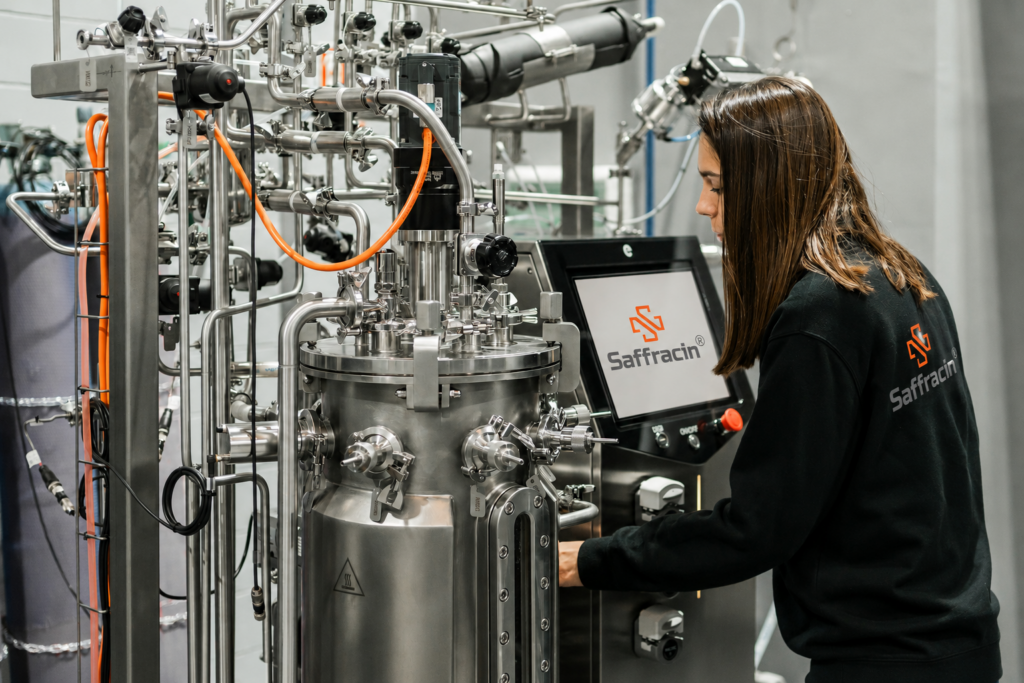
Quality control and manufacturing
Saffracin™ is produced by Samanik Salamat Gostar Co. in Tehran, Iran. Kaihan Therapeutics is the exclusive supplier in Korea, as approved in Samanik’s signed statement L07-R2 (20 October 2026).
A Certificate of Analysis is issued for every lot: crocins and safranal (HPLC), ash, loss on drying, heavy metals and microbiology.
Ten recent lots (2023 to 2026) are within specification, with crocins of 35.4 to 36.7%. Shelf life is 3 years.